
The source files can be found in user_guide/.
Choosing a strategy
The previous pages showed how to call each tool. This one is about which to reach for. There is no single best optimiser — the right choice falls out of four questions about your situation. The worked, end-to-end investor profiles live in putting it together; this page is the decision framework behind them.
The four questions
How much compute can you spend per rebalance? Naive optimisers (
InverseVolatility,EqualWeighted) are instant and solver-free. JuMP optimisers (MeanRisk,RiskBudgeting) solve a convex program — fast, but not free. Meta-optimisers (NestedClustered,Stacking) and cross-validated tuning stack many solves and cost the most.How often do you rebalance? High frequency rewards cheap, stable rules and tight
Turnover/Feescontrol so costs do not eat the edge. Infrequent rebalancing can afford a heavier, more bespoke optimisation each time.How much do you trust your estimates? If you have genuine forecasts, fold them in with a view prior (
BlackLittermanPrior,EntropyPoolingPrior). If you mostly distrust the noise in the moments, make the optimisation robust (UncertaintySetVariance, a worst-case mean) or lean on the correlation hierarchy (HierarchicalRiskParity) rather than point estimates.How large and constrained is the capital? Small accounts need
GreedyAllocationto round into whole shares without wasting cash. Institutional mandates pile on constraints — weight bounds, group limits, tracking — which is exactly what the JuMP optimisers are built for.
A rough map
| Situation | Reach for |
|---|---|
| Minimal compute, just want diversification | InverseVolatility / EqualWeighted |
| Classic risk/return trade-off | MeanRisk with an objective + efficient frontier |
| Want each holding to carry equal risk | RiskBudgeting |
| Care about tail losses or drawdowns, not just variance | swap MeanRisk's r to a tail (ConditionalValueatRisk) or drawdown (MaximumDrawdown) measure |
| Many assets, unstable covariance | HierarchicalRiskParity and clustering optimisers |
| Distrust a single fit, want robustness | NestedClustered / Stacking, or uncertainty sets |
| Have real views | BlackLittermanPrior / EntropyPoolingPrior |
| Tight rebalancing budget | add Turnover / Fees to a JuMPOptimiser |
| Trading real money | finish with GreedyAllocation |
These are starting points, not rules — most real strategies combine several (a view prior and constraints and finite allocation). The putting-it-together profiles walk three complete examples end to end.
The choice is real
To make the point concrete: three archetypes from the map — pure diversification, the risk/return workhorse, and the hierarchy-based rule — produce visibly different portfolios on the same data. Picking a strategy is picking one of these shapes.
using PortfolioOptimisers, CSV, TimeSeries, Clarabel, StatsPlots, GraphRecipes

X = TimeArray(CSV.File(joinpath(@__DIR__, "../examples/SP500.csv.gz")); timestamp = :Date)[(end - 252):end]
rd = prices_to_returns(X)
pr = prior(EmpiricalPrior(), rd)

slv = Solver(; name = :clarabel, solver = Clarabel.Optimizer,
             settings = Dict("verbose" => false),
             check_sol = (; allow_local = true, allow_almost = true))

res_ew = optimise(EqualWeighted(), rd)
res_mr = optimise(MeanRisk(; obj = MinimumRisk(),
                           opt = JuMPOptimiser(; pe = pr, slv = slv)))
res_hrp = optimise(HierarchicalRiskParity(; r = Variance(),
                                          opt = HierarchicalOptimiser(; pe = pr,
                                                                      cle = clusterise(ClustersEstimator(),
                                                                                       pr.X))))

plot_stacked_bar_composition([res_ew, res_mr, res_hrp], rd;
                             xticks = (1:3, ["EqualWeighted", "MinRisk", "HRP"]))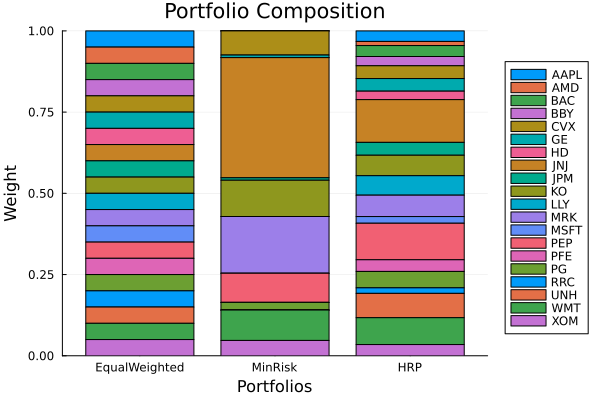
This page was generated using Literate.jl.