
The source files can be found in examples/.
Profile: retail, daily
The earlier examples each isolate one piece of the pipeline. The putting-it-together profiles run the whole pipeline end to end for a concrete investor, so you can see how the choices compose. This first profile is a retail investor rebalancing daily with a small account: the constraints are compute, trading cost, and capital, not sophistication.
The reasoning, following the strategy decision framework:
Compute is cheap but frequent — rebalancing every day rules out heavy optimisations; a single convex solve is right.
Trading is the enemy — daily turnover compounds costs, so we cap turnover and charge fees explicitly, letting the optimiser trade only when it is worth it.
The account is small — discretisation matters, so finite allocation is not an afterthought.
Robustness over edge — a tight weight cap buys diversification and stability.
When to reach for this
This is the template for any cost- and capital-constrained, high-frequency book: keep the optimisation light, control turnover and fees at the optimiser, and finish with a finite allocation sized to the real account.
using PortfolioOptimisers, CSV, TimeSeries, DataFrames, PrettyTables, Clarabel, StatsPlots,
      GraphRecipes

resfmt = (v, i, j) -> begin
    return if j == 1
        v
    else
        isa(v, AbstractFloat) ? "$(round(v*100, digits=3)) %" : v
    end
end;
1. Data and current book
We use the S&P 500 slice, and assume the investor currently holds an equal-weight book — the reference point turnover is measured against.
X = TimeArray(CSV.File(joinpath(@__DIR__, "..", "SP500.csv.gz")); timestamp = :Date)[(end - 252):end]
rd = prices_to_returns(X)
pr = prior(EmpiricalPrior(), rd)
N = length(rd.nx)

prices = vec(values(X)[end, :])
current_book = fill(1 / N, N)

slv = Solver(; name = :clarabel, solver = Clarabel.Optimizer,
             settings = Dict("verbose" => false),
             check_sol = (; allow_local = true, allow_almost = true))
Solver
name ┼ Symbol: :clarabel
solver ┼ UnionAll: Clarabel.MOIwrapper.Optimizer
settings ┼ Dict{String, Bool}: Dict{String, Bool}("verbose" => 0)
check_sol ┼ @NamedTuple{allow_local::Bool, allow_almost::Bool}: (allow_local = true, allow_almost = true)
add_bridges ┴ Bool: true2. The optimisation
One light convex solve: minimum risk, a 15% per-name cap for diversification, a daily turnover budget against the current book, and explicit fees so trades must justify their cost.
retail = optimise(MeanRisk(; obj = MinimumRisk(),
                           opt = JuMPOptimiser(; pe = pr, slv = slv,
                                               wb = WeightBounds(; lb = 0.0, ub = 0.15),
                                               tn = Turnover(; w = current_book,
                                                             val = 0.05),
                                               fees = Fees(; l = 0.001))))

pretty_table(DataFrame("Asset" => rd.nx, "Current" => current_book, "Target" => retail.w);
             formatters = [resfmt],
             title = "Retail daily target — capped, low-turnover, net of fees")
Retail daily target — capped, low-turnover, net of fees
┌────────┬─────────┬─────────┐
│ Asset │ Current │ Target │
│ String │ Float64 │ Float64 │
├────────┼─────────┼─────────┤
│ AAPL │ 5.0 % │ 0.0 % │
│ AMD │ 5.0 % │ 0.0 % │
│ BAC │ 5.0 % │ 0.0 % │
│ BBY │ 5.0 % │ 0.0 % │
│ CVX │ 5.0 % │ 10.0 % │
│ GE │ 5.0 % │ 0.246 % │
│ HD │ 5.0 % │ 0.721 % │
│ JNJ │ 5.0 % │ 10.0 % │
│ JPM │ 5.0 % │ 4.818 % │
│ KO │ 5.0 % │ 10.0 % │
│ LLY │ 5.0 % │ 4.804 % │
│ MRK │ 5.0 % │ 10.0 % │
│ MSFT │ 5.0 % │ 0.0 % │
│ PEP │ 5.0 % │ 10.0 % │
│ ⋮ │ ⋮ │ ⋮ │
└────────┴─────────┴─────────┘
6 rows omittedThe cap and turnover budget keep the book diversified and close to where it started, so the daily rebalance is small and cheap.
3. Finite allocation
The account is $10,000. GreedyAllocation converts the target into whole shares — no MIP solver, instant, which suits a daily cadence.
alloc = optimise(GreedyAllocation(),
                 FiniteAllocationInput(; w = retail.w, prices = prices, cash = 10_000.0))

invested = sum(alloc.shares .* prices)
pretty_table(DataFrame("Asset" => rd.nx, "Target" => retail.w,
                       "Shares" => round.(Int, alloc.shares), "Realised" => alloc.w);
             formatters = [resfmt],
             title = "\$10,000 allocated — invested \```math(round(Int, invested)), cash left \```(round(alloc.cash, digits = 2))")
$10,000 allocated — invested ```math(round(Int, invested)), cash left ```(roun ⋯
┌────────┬─────────┬────────┬──────────┐
│ Asset │ Target │ Shares │ Realised │
│ String │ Float64 │ Int64 │ Float64 │
├────────┼─────────┼────────┼──────────┤
│ AAPL │ 0.0 % │ 0 │ 0.0 % │
│ AMD │ 0.0 % │ 0 │ 0.0 % │
│ BAC │ 0.0 % │ 0 │ 0.0 % │
│ BBY │ 0.0 % │ 0 │ 0.0 % │
│ CVX │ 10.0 % │ 6 │ 10.427 % │
│ GE │ 0.246 % │ 0 │ 0.0 % │
│ HD │ 0.721 % │ 0 │ 0.0 % │
│ JNJ │ 10.0 % │ 5 │ 8.707 % │
│ JPM │ 4.818 % │ 3 │ 3.888 % │
│ KO │ 10.0 % │ 15 │ 9.394 % │
│ LLY │ 4.804 % │ 2 │ 7.264 % │
│ MRK │ 10.0 % │ 9 │ 9.865 % │
│ MSFT │ 0.0 % │ 0 │ 0.0 % │
│ PEP │ 10.0 % │ 5 │ 8.967 % │
│ ⋮ │ ⋮ │ ⋮ │ ⋮ │
└────────┴─────────┴────────┴──────────┘
6 rows omitted4. The book
plot_stacked_bar_composition([retail], rd; xticks = (1:1, ["Retail daily"]))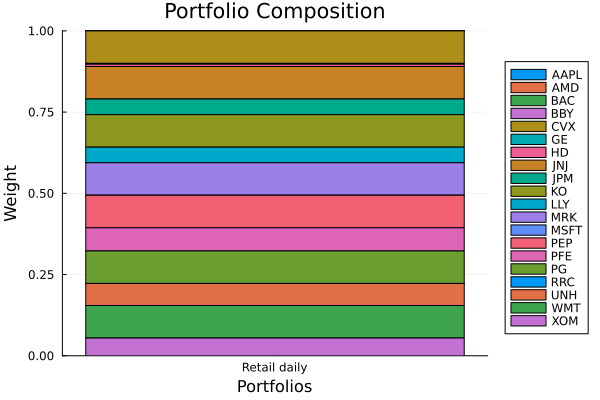
This page was generated using Literate.jl.