
The source files can be found in examples/.
Turnover and tracking
The constraints so far shape what the portfolio holds. Turnover and tracking constrain how it moves: how far it may drift from your current book when you rebalance, and how far it may stray from a benchmark. Both come in two flavours in PortfolioOptimisers.jl — as a constraint on a JuMPOptimiser, or as a risk measure you minimise directly — and the choice between them is the difference between "respect this limit" and "make this the goal".
Turnover (
Turnoverviatn, orTurnoverRiskMeasure) penalises trading away from a reference weight vector.Tracking (
TrackingErrorviatr, orTrackingRiskMeasure) penalises deviation from a benchmark, specified either as weights (WeightsTracking) or as a benchmark return series (ReturnsTracking— e.g. an index).
When to reach for this
Reach for turnover when trading is costly and you rebalance often — you want the new book close to the old one. Reach for tracking when you are benchmarked: index replication (minimise tracking error) or enhanced indexing (seek return subject to a tracking-error budget). Use the constraint form when the limit is a hard mandate, the risk-measure form when staying put / hugging the benchmark is itself the objective.
using PortfolioOptimisers, CSV, TimeSeries, DataFrames, PrettyTables, Clarabel, StatsPlots,
      GraphRecipes

resfmt = (v, i, j) -> begin
    return if j == 1
        v
    else
        isa(v, AbstractFloat) ? "$(round(v*100, digits=3)) %" : v
    end
end;
1. Data and a benchmark
We use the S&P 500 slice, and two benchmarks: an equal-weight book (a weight vector) and the S&P 500 index itself (a return series).
X = TimeArray(CSV.File(joinpath(@__DIR__, "..", "SP500.csv.gz")); timestamp = :Date)[(end - 252):end]
rd = prices_to_returns(X)
pr = prior(EmpiricalPrior(), rd)
N = length(rd.nx)

idx = TimeArray(CSV.File(joinpath(@__DIR__, "..", "SP500_idx.csv.gz")); timestamp = :Date)
index_returns = vec(values(percentchange(idx)))[(end - 251):end]

slv = Solver(; name = :clarabel, solver = Clarabel.Optimizer,
             settings = Dict("verbose" => false),
             check_sol = (; allow_local = true, allow_almost = true))
rf = 4.2 / 100 / 252

equal_weight = fill(1 / N, N)
20-element Vector{Float64}:
0.05
0.05
0.05
0.05
0.05
0.05
0.05
0.05
0.05
0.05
0.05
0.05
0.05
0.05
0.05
0.05
0.05
0.05
0.05
0.052. Turnover as a constraint
Turnover (tn) limits how far the weights may move from a reference book w — your current holdings — so a rebalance stays cheap. We seek the maximum-ratio portfolio but anchor it at the equal-weight book and tighten the per-name turnover budget val. A smaller budget keeps the result closer to where we started.
turnover_vals = [0.005, 0.02, 0.1, 0.5]
turnover_res = [optimise(MeanRisk(; obj = MaximumRatio(; rf = rf),
                                  opt = JuMPOptimiser(; pe = pr, slv = slv,
                                                      tn = Turnover(; w = equal_weight,
                                                                    val = v))))
                for v in turnover_vals]

drift(w) = sum(abs, w .- equal_weight)
pretty_table(DataFrame("Turnover budget" => turnover_vals,
                       "Drift from start" => drift.(getproperty.(turnover_res, :w)),
                       "Max weight" => maximum.(getproperty.(turnover_res, :w)));
             formatters = [resfmt],
             title = "Tighter turnover budget keeps the book near the reference")
Tighter turnover budget keeps the book near the reference
┌─────────────────┬──────────────────┬────────────┐
│ Turnover budget │ Drift from start │ Max weight │
│ Float64 │ Float64 │ Float64 │
├─────────────────┼──────────────────┼────────────┤
│ 0.005 │ 10.0 % │ 5.5 % │
│ 0.02 │ 40.0 % │ 7.0 % │
│ 0.1 │ 125.917 % │ 15.0 % │
│ 0.5 │ 170.0 % │ 55.0 % │
└─────────────────┴──────────────────┴────────────┘3. Turnover as a risk measure
TurnoverRiskMeasure makes minimising turnover the objective rather than a side constraint. Minimising turnover from the current book with no other pull simply returns the current book — useful as one term in a multi-objective problem, or to measure the trading cost of a target.
res_min_turnover = optimise(MeanRisk(; r = TurnoverRiskMeasure(; w = equal_weight),
                                     obj = MinimumRisk(),
                                     opt = JuMPOptimiser(; pe = pr, slv = slv)))
MeanRiskResult
jr ┼ JuMPOptimisationResult
│ pa ┼ ProcessedJuMPOptimiserAttributes
│ │ pr ┼ LowOrderPrior
│ │ │ X ┼ 252×20 Matrix{Float64}
│ │ │ mu ┼ 20-element Vector{Float64}
│ │ │ sigma ┼ 20×20 Matrix{Float64}
│ │ │ chol ┼ nothing
│ │ │ w ┼ nothing
│ │ │ ens ┼ nothing
│ │ │ kld ┼ nothing
│ │ │ ow ┼ nothing
│ │ │ rr ┼ nothing
│ │ │ f_mu ┼ nothing
│ │ │ f_sigma ┼ nothing
│ │ │ f_w ┴ nothing
│ │ wb ┼ WeightBounds
│ │ │ lb ┼ 20-element StepRangeLen{Float64, Base.TwicePrecision{Float64}, Base.TwicePrecision{Float64}, Int64}
│ │ │ ub ┴ 20-element StepRangeLen{Float64, Base.TwicePrecision{Float64}, Base.TwicePrecision{Float64}, Int64}
│ │ lt ┼ nothing
│ │ st ┼ nothing
│ │ lcsr ┼ nothing
│ │ ctr ┼ nothing
│ │ gcardr ┼ nothing
│ │ sgcardr ┼ nothing
│ │ smtx ┼ nothing
│ │ sgmtx ┼ nothing
│ │ slt ┼ nothing
│ │ sst ┼ nothing
│ │ sglt ┼ nothing
│ │ sgst ┼ nothing
│ │ tn ┼ nothing
│ │ fees ┼ nothing
│ │ plr ┼ nothing
│ │ ret ┼ ArithmeticReturn
│ │ │ ucs ┼ nothing
│ │ │ lb ┼ nothing
│ │ │ mu ┴ 20-element Vector{Float64}
│ retcode ┼ OptimisationSuccess
│ │ res ┴ Dict{Any, Any}: Dict{Any, Any}()
│ sol ┼ JuMPOptimisationSolution
│ │ w ┴ 20-element Vector{Float64}
│ model ┼ A JuMP Model
│ │ ├ solver: Clarabel
│ │ ├ objective_sense: MIN_SENSE
│ │ │ └ objective_function_type: AffExpr
│ │ ├ num_variables: 21
│ │ ├ num_constraints: 4
│ │ │ ├ AffExpr in MOI.EqualTo{Float64}: 1
│ │ │ ├ Vector{AffExpr} in MOI.Nonnegatives: 1
│ │ │ ├ Vector{AffExpr} in MOI.Nonpositives: 1
│ │ │ └ Vector{AffExpr} in MOI.NormOneCone: 1
│ │ └ Names registered in the model
│ │ └ :bgt, :cturnover_r_noc_1, :k, :lw, :obj_expr, :ret, :risk, :risk_vec, :sc, :so, :turnover_r_1, :turnover_risk_1, :w, :w_lb, :w_ub
fb ┴ nothing4. Tracking a benchmark
TrackingRiskMeasure minimises the tracking error to a benchmark. With a WeightsTracking benchmark it reproduces that book exactly; with a ReturnsTracking benchmark — here the S&P 500 index return series — it builds the replicating portfolio from our 20 assets that best tracks the index.
res_replicate_ew = optimise(MeanRisk(;
                                     r = TrackingRiskMeasure(;
                                                             tr = WeightsTracking(;
                                                                                  w = equal_weight)),
                                     obj = MinimumRisk(),
                                     opt = JuMPOptimiser(; pe = pr, slv = slv)))
res_replicate_idx = optimise(MeanRisk(;
                                      r = TrackingRiskMeasure(;
                                                              tr = ReturnsTracking(;
                                                                                   w = index_returns)),
                                      obj = MinimumRisk(),
                                      opt = JuMPOptimiser(; pe = pr, slv = slv)))

pretty_table(DataFrame("Asset" => rd.nx, "Replicate EW" => res_replicate_ew.w,
                       "Replicate index" => res_replicate_idx.w); formatters = [resfmt],
             title = "Pure tracking: equal-weight book vs index replication")
Pure tracking: equal-weight book vs index replication
┌────────┬──────────────┬─────────────────┐
│ Asset │ Replicate EW │ Replicate index │
│ String │ Float64 │ Float64 │
├────────┼──────────────┼─────────────────┤
│ AAPL │ 5.0 % │ 13.692 % │
│ AMD │ 5.0 % │ 6.689 % │
│ BAC │ 5.0 % │ 3.613 % │
│ BBY │ 5.0 % │ 1.767 % │
│ CVX │ 5.0 % │ 3.767 % │
│ GE │ 5.0 % │ 7.456 % │
│ HD │ 5.0 % │ 8.681 % │
│ JNJ │ 5.0 % │ 0.001 % │
│ JPM │ 5.0 % │ 7.861 % │
│ KO │ 5.0 % │ 3.52 % │
│ LLY │ 5.0 % │ 2.906 % │
│ MRK │ 5.0 % │ 3.55 % │
│ MSFT │ 5.0 % │ 18.432 % │
│ PEP │ 5.0 % │ 5.272 % │
│ ⋮ │ ⋮ │ ⋮ │
└────────┴──────────────┴─────────────────┘
6 rows omitted5. Enhanced indexing: tracking as a constraint
The more interesting case is enhanced indexing — seek return, but stay within a tracking-error budget of the benchmark. TrackingError (tr) bounds the tracking error to err. We maximise the ratio while tightening err against the equal-weight benchmark: a small err hugs the benchmark, a large one frees the optimiser to chase return.
err_vals = [0.0005, 0.001, 0.005, 0.02]
track_res = [optimise(MeanRisk(; obj = MaximumRatio(; rf = rf),
                               opt = JuMPOptimiser(; pe = pr, slv = slv,
                                                   tr = TrackingError(;
                                                                      tr = WeightsTracking(;
                                                                                           w = equal_weight),
                                                                      err = e))))
             for e in err_vals]

pretty_table(DataFrame("Tracking-error budget" => err_vals,
                       "Drift from benchmark" => drift.(getproperty.(track_res, :w)),
                       "Max weight" => maximum.(getproperty.(track_res, :w)));
             formatters = [resfmt],
             title = "Tighter tracking-error budget hugs the benchmark")
Tighter tracking-error budget hugs the benchmark
┌───────────────────────┬──────────────────────┬────────────┐
│ Tracking-error budget │ Drift from benchmark │ Max weight │
│ Float64 │ Float64 │ Float64 │
├───────────────────────┼──────────────────────┼────────────┤
│ 0.0005 │ 15.77 % │ 7.81 % │
│ 0.001 │ 31.247 % │ 10.606 % │
│ 0.005 │ 106.974 % │ 26.905 % │
│ 0.02 │ 180.0 % │ 66.03 % │
└───────────────────────┴──────────────────────┴────────────┘The tracking error itself can be measured with different norms — L1Norm (absolute, sparse), LpNorm (general p-norm), LInfNorm (worst single deviation) — passed as the alg, so you can choose whether to penalise the total drift or the largest single bet away from the benchmark.
6. Comparing the approaches
results = [res_replicate_ew, track_res[1], track_res[3], turnover_res[2]]
labels = ["Replicate EW", "Track err 5e-4", "Track err 5e-3", "Turnover 0.02"]

plot_stacked_bar_composition(results, rd; xticks = (1:length(labels), labels))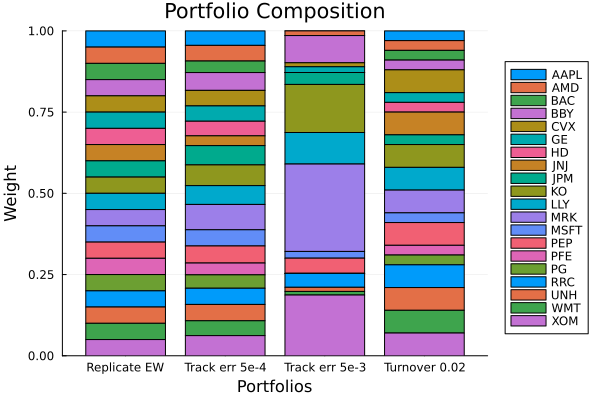
This page was generated using Literate.jl.